The global online gambling market is valued at $101.45 billion in 2026 and, according to Mordor Intelligence, is expected to reach $168.71 billion by 2031, with an average annual growth rate of 10.72%. Mobile devices already account for more than 53% of the industry’s revenue. The 18-24 age group is showing the highest growth rates — 11.98% annually. New jurisdictions — from Brazil to Thailand — are opening doors to licensed operators.
If there has ever been a good time to launch your own gambling project, it is now.
However, there is a considerable distance between an ambitious idea and the first registered player. Which business model should you choose? Where should you get a license? How do you connect payment systems that actually work with gambling?
In this article, we will break down the entire process — from the first business plan to the moment when the platform starts accepting bets.
Define Your Business Model: White Label, Turnkey, or Development from Scratch
Before diving into technical details, you need to answer the main question: which business model are you choosing? Everything depends on this — budget, timeframe, level of control, and scaling prospects.
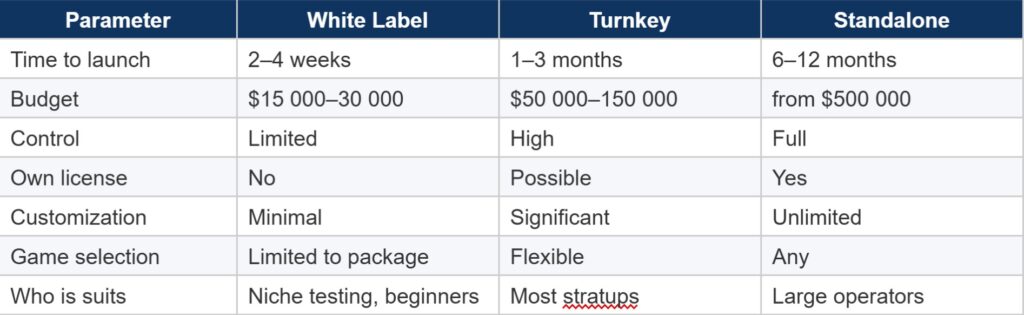
White Label is the fastest path to market. The operator receives a ready-made platform under the provider’s license. Launch takes two to four weeks, investment starts from $15,000. This option is good for testing a niche with minimal risks. The downside is limited control: you don’t own the code and are tied to the partner’s terms.
Turnkey is the happy medium. A fully configured platform under your brand with the possibility of your own license. Launch takes one to three months, budget ranges from $50,000 to $150,000.
For most new operators in 2026, Turnkey remains the optimal choice. It provides a balance between speed to market and the ability to build a unique brand.
Standalone is platform development from scratch. Full control and uniqueness, but costs start from $500,000, and timeframes are six to twelve months. Justified for large operators with serious capital.
Business model comparison table:
Choose a Jurisdiction and Obtain a License
A license is the foundation of your business. Without it, you cannot legally accept payments, sign agreements with game providers, or work with major affiliates. The choice of jurisdiction determines not only the cost of entry but also market geography, brand reputation, and access to payment infrastructure.
Curacao is one of the most popular jurisdictions for startups. Since 2024, the new Curacao Gaming Authority (CGA) has been in effect with stricter requirements: mandatory KYC, fund segregation, and Responsible Gambling.
Cost is from $15,000-20,000, the process takes 2-4 months. The advantage is a low entry barrier. The disadvantage is that some European markets do not recognize this license.
Malta Gaming Authority (MGA) is the gold standard of the industry. It opens doors to premium European markets. Cost is from 25,000 euros, the process takes 4-6 months.
Requirements are stricter: a physical office in Malta, minimum capital, a Responsible Gambling system, and a “fit and proper” test. In return — one of the most respected licenses in the world.
Anjouan is a rapidly growing jurisdiction with low costs. Suitable for operators in Asian and African markets.
More details about the regulatory landscape can be found in our article “Compliance in iGaming: How to Stay Within the Law”.
Choose a Platform and Integrate Gaming Content
The platform is the heart of an online casino. The quality of operation, loading speed, and scalability all depend on it.
A modern iGaming platform includes a back office, a Player Account Management system, integration with aggregators through a single API, a bonus system, Responsible Gambling tools, and CRM.
We wrote about the differences between modern and traditional solutions in the article “What Is a Modern iGaming Platform”.
The average operator in 2026 offers from 3,000 to 10,000 games. The minimum set includes: slots from Pragmatic Play, Play’n GO, NetEnt; table games; live casino from Evolution.
Crash games are becoming an increasingly essential element. According to Spribe, Aviator has more than 50 million active users per month. More details can be found in the article “Crash Games: The Fastest-Growing Casino Segment”.
Game integration is done through aggregators — SoftSwiss, Slotegrator, EveryMatrix — or directly. A single integration opens access to thousands of games from dozens of studios.
Connect Payment Systems
Payment processing is the lifeblood of a casino. If a deposit cannot be made in a couple of clicks — the player leaves. If a withdrawal is delayed by a day — they won’t come back.
The minimum set in 2026: bank cards through specialized iGaming processors, e-wallets (Skrill, Neteller, MiFinity), local methods for target markets, and cryptocurrencies.
Stablecoins (USDT and USDC) account for over 70% of all crypto payments in gambling, and the total volume of crypto bets exceeds $65 billion. More about the role of blockchain can be found in the article “Blockchain and Cryptocurrencies in iGaming”.
Experience with iGaming specifically is critically important for the provider. Many universal processors refuse to work with gambling or impose prohibitive fees.
A review of the best providers can be found in the article “Top Payment Gateway Providers for iGaming”. A detailed guide on criteria can be found in the article “Payment Systems for Online Casinos”.
Take Care of Design, UX, and Mobile Version
Design is not just a pretty picture, but a conversion tool. Thousands of casinos offer the same games. What sets winners apart from the mediocre is visual identity and user experience.
We wrote about the importance of unique branding in the article “Why Unique Design Is Critically Important for Online Casino Success”.
In 2026, the absolute priority is the mobile version. According to Mordor Intelligence, mobile devices account for 53.65% of the industry’s revenue, with growth of 13.65% annually.
The platform must work on smartphones as a full-fledged mobile product, not as an adaptive version of the desktop. Every extra second means lost registrations and uncompleted deposits.
More details can be found in the article “Mobile Casino: Why Smartphones Are Replacing PCs”.
Set Up a Bonus System and Attract Your First Players
Bonuses are the main tool for attracting players. But thoughtless distribution of money destroys casino economics faster than the absence of customers.
The standard set: a welcome package (100%-200% on the first deposit + free spins), reload bonuses, cashback, and a multi-level loyalty system.
The key point is wagering requirements. The average wager in 2026 is 30x-40x. Too high scares off experienced players, too low attracts bonus hunters.
A detailed breakdown of mechanics can be found in the article “How Bonuses Work in Online Casinos”.
Main traffic channels: affiliate programs, SEO and content marketing, paid advertising, streaming on Twitch and YouTube.
According to RichAds, creatives are becoming increasingly personalized thanks to AI. Generation Z deserves special attention — traditional banners are no longer enough for them.
Important: gambling advertising is strictly regulated. Violating the rules can result in fines and license revocation.
Common Mistakes at Launch: What to Avoid
Behind every failed project is a set of recurring mistakes. We have collected the most common ones — and recommendations on how to avoid them.
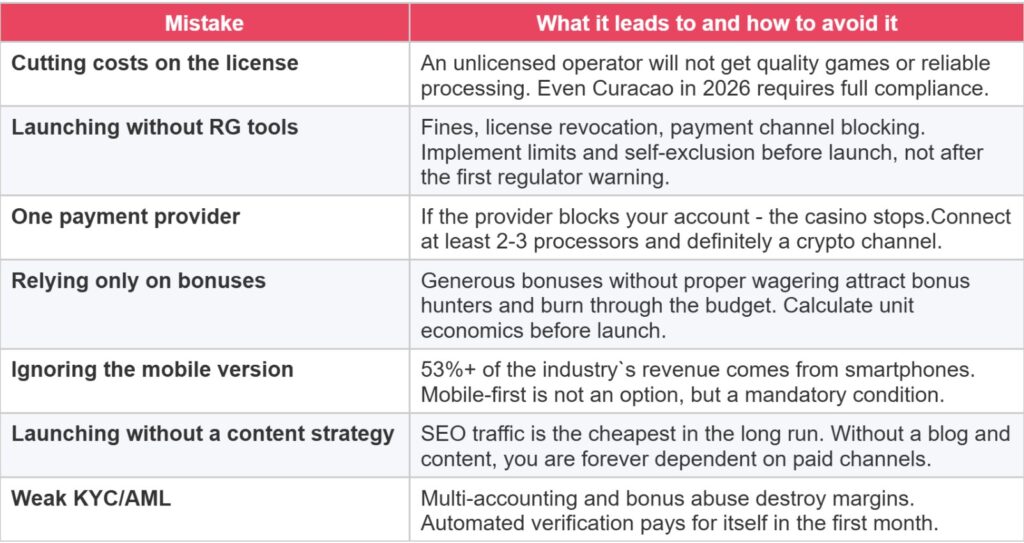
Most of these mistakes have one thing in common: trying to save on things you cannot afford to save on. License, security, payment infrastructure, and mobile UX are investments, not expenses.
Conclusion
Launching an online casino in 2026 is a large-scale but achievable project. A market worth over $100 billion continues to grow at double-digit rates.
White Label and Turnkey models allow you to enter the industry with reasonable investments and within a foreseeable timeframe. The main thing is a systematic approach.
Don’t skip any step. Every element is connected to the others, and a weak link will inevitably show itself — whether it’s inconvenient processing, lack of necessary games, or problems with the regulator.
If you are planning to launch an online casino and are looking for a reliable technology partner, the experts at INNOVAVENTIS are ready to offer Turnkey and White Label solutions with full support at every stage — from licensing to the first transactions.