The online gambling industry is undergoing another transformation, and at the center of these changes is a phenomenon that seemed like an experiment just five years ago — crash games. What started as a niche product for cryptocurrency casinos has now become one of the most dynamic and profitable segments of the entire iGaming industry. According to analysts, by early 2026, the flagship game Aviator by Spribe alone has over 50 million active users per month, and the crash game format demonstrates growth rates outpacing traditional slots and table games.
What is behind this explosive growth? Why does Generation Z choose crash games over classic slots? And what opportunities does this open for operators seeking to diversify their game portfolio? In this article, we will break down the mechanics of crash games, analyze the reasons for their popularity, and examine the development prospects for this segment in the coming years.
What Are Crash Games and How Do They Work
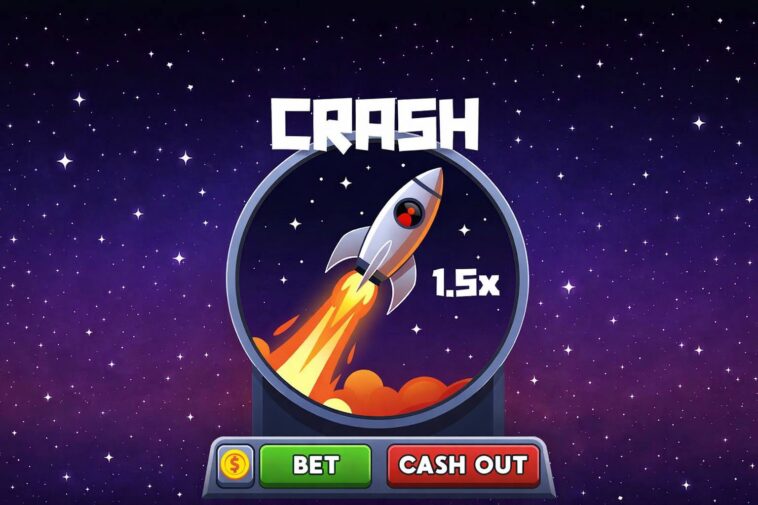
Crash games represent a fundamentally new format of gambling in which a player places a bet on a rising multiplier and must withdraw funds before that multiplier “falls” or “crashes.” The concept is extremely simple: after placing a bet, a graph or animated object (plane, rocket, spaceship) appears on the screen, which begins to rise upward while the multiplier increases — 1.1x, 1.5x, 2x, 5x, 10x and higher. The player’s task is to press the withdrawal button at the right moment. If the multiplier “crashes” before the player manages to withdraw funds, the bet is lost completely.
Technically, crash games operate on a random number generator that determines the crash point before the round begins. Most modern crash games use provably fair technology, allowing players to independently verify the fairness of each round through cryptographic hashes. This is especially important for cryptocurrency casino audiences, where trust in the platform is built on algorithm transparency.
The average RTP of crash games is around 97%, which is higher than most slots. At the same time, the mathematical model is built in such a way that approximately 3% of rounds end with an instant crash at the 1.0x multiplier, creating additional tension and unpredictability. Rounds last only a few seconds, allowing players to place significantly more bets per unit of time compared to traditional casino games.
Market Leaders and Their Features
The pioneer and undisputed leader of the segment remains Aviator by Polish developer Spribe, launched in 2019. This game set the genre standards and proved the viability of the format. A distinctive feature of Aviator is its social component — players see each other’s bets in real-time, can chat, and the “Rain” system periodically distributes free bets to active participants. This gamification transforms the crash game from an individual activity into a collective experience.
Spaceman by Pragmatic Play offers a space theme and adds the possibility of partial withdrawal — the player can take 50% of the bet while leaving the other half to grow further. JetX by SmartSoft Gamingemphasizes the visual component with detailed 3D graphics of a jet plane. Space XY by BGaming attracts audiences with multiple bets and bonus multipliers, while Cricket X by Smartsoft adapts the mechanics for cricket fans, which is especially relevant for the Indian market.
Each provider strives to differentiate their product through unique mechanics, visual solutions, or social features, but the basic formula remains unchanged — simplicity of rules combined with high emotional tension in each round.
Why Crash Games Are Conquering Generation Z
The phenomenal growth of crash games cannot be explained by successful mechanics alone. Behind this lies a deep correspondence between the format and the expectations and behavioral patterns of young audiences. Generation Z, raised in the era of TikTok and Instagram Reels, is accustomed to short-form content and instant gratification. A crash game round lasts mere seconds — this perfectly fits into clip thinking and the need for rapid change of impressions.
Unlike slots, where the player passively watches the reels spin, crash games create an illusion of control. The player makes the decision about when to withdraw, which is psychologically perceived as a display of skill, although mathematically the outcome is determined randomly. This line between luck and perceived mastery makes crash games especially attractive to audiences skeptical of the “pure randomness” of traditional slots.
The social component also plays a key role. Streaming crash games on Twitch and YouTube has become a separate content genre, and bloggers demonstrating big wins at high multipliers create a viral effect and attract new audiences. Crash games are ideal for streaming — short rounds with high emotional intensity hold viewers’ attention much better than monotonous slot spinning.
Finally, the close connection of crash games with the cryptocurrency ecosystem attracts a technically advanced audience that values transaction anonymity, instant payouts, and provably fair algorithm transparency. For many young players, crash games become the entry point into the world of online gambling precisely through cryptocurrency casinos.
Opportunities for Operators
For online casino operators, crash games represent a strategically important segment for several reasons. First, the high speed of rounds means more bets per session, which with proper margin management ensures stable monetization even at relatively high RTP. Second, crash games attract a demographic that is traditionally weakly engaged in classic gambling — young men aged 18-30 with cryptocurrency investment experience and interest in technology.
Integrating crash games into an existing portfolio does not require significant investment. Leading content aggregators such as Slotegrator, SoftSwiss, and EveryMatrix offer ready-to-integrate solutions from Spribe, Pragmatic Play, SmartSoft, and other providers. For operators working in emerging markets — India, Brazil, African countries — crash games often become the anchor product around which the entire platform offering is built.
Special attention deserves the integration of crash games into Telegram bots and mini-applications. This distribution channel is rapidly gaining popularity in 2026, especially in markets with limited access to traditional casino platforms. The ease and speed of crash games make them an ideal format for mobile gambling, where users expect an instant gaming experience without downloading applications.
Regulatory Aspects and Responsible Gaming
The rapid growth of crash games has not gone unnoticed by regulators. The high speed of rounds and the illusion of control over outcomes raise legitimate concerns about problem gambling risks. Operators working in regulated jurisdictions need to pay special attention to responsible gaming tools — deposit limits, session times, forced breaks, and self-exclusion mechanisms.
In the UK and several European countries, additional restrictions for “fast” gaming formats are already being discussed, including mandatory pauses between rounds and bans on automatic betting. Operators should proactively implement player protection measures without waiting for regulatory pressure — this not only reduces reputational risks but also builds audience trust in the platform.
What’s Next: Crash Game Development Trends
The evolution of crash games continues. Developers are experimenting with hybrid formats combining crash mechanics with bonus rounds and progressive jackpots. Social features are becoming increasingly sophisticated — group bets, tournaments, leaderboards with prize pools are turning crash games into a full-fledged competitive discipline.
Virtual and augmented reality technologies are opening new horizons for immersive crash gambling experiences. Imagine a VR environment where you are physically inside a launching rocket and make the exit decision by literally pressing the ejection button. Such experiments are already being conducted in the laboratories of leading providers.
Crash games are not a temporary fad but a fundamental shift in player preferences. For operators seeking to remain competitive in 2026 and beyond, integrating quality crash games into their portfolio is becoming not an option but a necessity.