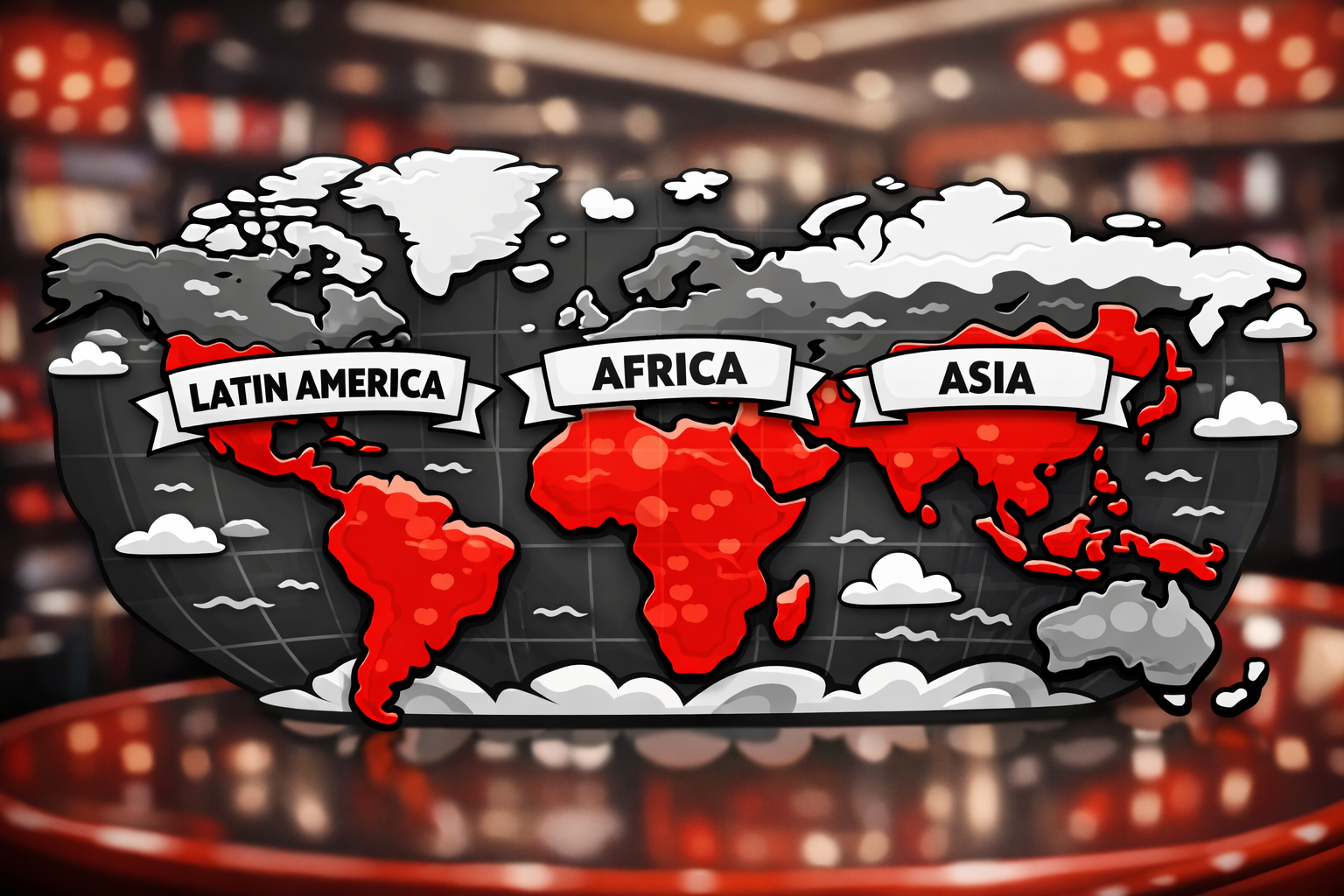
While European regulators raise taxes (UK — 39%, Netherlands — 37.8%) and competition in mature markets reaches its limit, the most interesting iGaming stories of 2026 are unfolding in entirely different regions.
Brazil closed 2025 with €5.96 billion in gaming revenue and 78 licensed operators — and this is only the first full year of regulation. The African market exceeded $3.2 billion, and 70% of the subcontinent’s population is under 30. The Asia-Pacific region generates $19 billion in iGaming revenue, while the Philippines showed GGR growth of 25% year-over-year — to $7.16 billion (data from PAGCOR). For operators ready to invest in localization, compliance, and a mobile-first product, these markets are not an abstract “future,” but a concrete opportunity right now.
In this article, we will cover the key emerging markets, their regulatory environment, size, payment infrastructure, and entry strategies.
Opportunity Map: 9 Markets in One Table
Before diving into details, here is a summary table of key parameters. It will help you quickly assess which market matches your budget, target audience, and readiness for regulatory challenges.
| Parameter | Brazil | Mexico | Nigeria | Kenya | South Africa | Philippines | India | Thailand |
|---|---|---|---|---|---|---|---|---|
| Population | 216M | 130M | 230M | 55M | 62M | 117M | 1.4B | 72M |
| GGR 2025 | €5.96B | ~$1.5B | $1.1B | $677M | $3.3B | $7.16B | $6.91B | Gray market |
| Regulator | SPA/MF | SEGOB | NLRC | BCLB | NGB | PAGCOR | 7 states | None (draft law) |
| Status | Regulated | Regulated | Transitional | Mature | Mature | Mature | Fragmented | Pre-reg. |
| GGR Tax | 12→18% | 30% | Various | 15% | Various | 25% | 28% GST | — |
| License | R$30M | Various | NLRC/Lagos | BCLB | NGB | PAGCOR | State-level | — |
| Payments | Pix, cards | SPEI, cards | M-Pesa, bank | M-Pesa | EFT, cards | GCash, Maya | UPI, Paytm | PromptPay |
| Mobile-first | ~80% | ~70% | ~95% | ~94% | ~75% | ~73% | ~85% | ~80% |
| Crypto | Prohibited | Gray zone | Permitted | Permitted | Limited | Limited | Gray zone | No |
| Entry barrier for operator | High ($5.2M) | Medium | Low | Medium | High | Medium | Medium | Waiting |
GGR data: H2 Gambling Capital, Mordor Intelligence, PAGCOR, SPA/MF Brazil. More about licensing — Why Anjouan Has Become an Alternative to Malta and Curaçao for iGaming.
Latin America: Brazil as the Epicenter and Regional Effect
Brazil is the main iGaming story of 2026. Since January 1, 2025, online betting and iGaming have been regulated by federal law (Law 14.790/2023) under the control of Secretaria de Prêmios e Apostas (SPA). A single federal license costs ~$5.2 million, covers up to 3 brands, and is valid for 5 years.
The numbers are impressive: 216 million population, 80%+ mobile traffic, 3.2 billion visits to iGaming sites back in 2022 (before regulation!). The Pix payment system — instant transfers via QR code — has become the standard for deposits. Credit cards are prohibited for betting, as are cryptocurrencies (although Brazil is developing a CBDC called “Drex”).
Challenges: the GGR tax has already been raised from 12% to 18%, which squeezes margins. An estimated 30–40% of the market remains illegal — offshore operators offer better odds due to the absence of a tax burden. But legal operators gain access to advertising on Google, Meta, and YouTube — something that has been denied to illegal operators since 2025.
Neighbors — Mexico, Colombia, Peru, Chile — are closely watching the Brazilian experiment. Brazil is already becoming an operational hub for the entire region.
| Country | Opportunities | Challenges |
|---|---|---|
| Brazil | 216M population, €5.96B GGR, Pix ecosystem, 80%+ mobile, sports culture | R$30M license ($5.2M), GGR tax rising to 18%, crypto ban, 30–40% illegal market |
| Mexico | 130M population, 2nd LatAm market, SEGOB regulation since 2004 | 30% GGR tax, limited online advertising, slow license issuance |
| Colombia | Coljuegos — progressive regulator, growing market, 15% GGR tax | Small market, competition from illegal operators, advertising restrictions |
| Peru / Chile | Watching Brazil, developing their own frameworks — potential markets 2027–2028 | No clear regulation yet, high gray market share |
Africa: A Mobile-First Continent with the World’s Youngest Population
70% of sub-Saharan Africa’s population is under 30. 75%+ of web traffic is mobile. Mobile money (M-Pesa, MTN MoMo) replaces bank cards. This is the ideal foundation for iGaming — and the market is already generating $3.2 billion, with a growth forecast of 6–8% annually (data from iGB / H2 Gambling Capital).
Nigeria — the largest market by population (230 million). Regulated by NLRC (National Lottery Regulatory Commission) at the federal level and the Lagos State Lottery Board at the state level. Football betting is the absolute leader. BC.Game just received a Nigerian license (April 2026), signaling growing interest from global operators.
Kenya — the most mature African market. 83.9% of adults have participated in betting (GeoPoll). The regulator is BCLB (Betting Control and Licensing Board). M-Pesa is the primary payment method. CAGR of 12.96% — the highest on the continent (data from Mordor Intelligence).
South Africa — the largest market by GGR ($3.3 billion), but 62% of online gambling is on illegal platforms. The main challenge is the lack of protection against offshore operators.
The key advantage of Africa for operators: CAC (customer acquisition cost) is 50–70% lower than in Europe. But the product must work on 2G/3G, load in less than 3 seconds, and take up less than 3 MB. About mobile optimization — in the article “Mobile Casino: Why Smartphones Are Replacing PCs”.
Asia: Scale, Fragmentation, and “Interest ≠ Revenue”
The Asia-Pacific iGaming market — $19 billion in 2024 (data from SourceCodeLab), with a projected CAGR of ~12% through 2028. But, as analysts at Blask aptly noted: “Interest doesn’t always equal revenue” — many markets with enormous demand remain regulatorily closed.
Philippines — the only fully regulated online market in the region. PAGCOR issues licenses, GGR in 2024 was $7.16 billion (+25% YoY). After the ban on POGO (offshore operators) in December 2024, the market refocused on domestic players. GCash and Maya are the primary payment methods.
India — a $6.91 billion market, with a forecast of $16.83 billion by 2033. But regulation is at the state level: 7 states have legalized real-money gaming, the rest are a gray zone. Cricket (IPL) is the main driver of betting. UPI and Paytm are payment standards. The largest number of gaming brands in Asia — an extremely competitive market.
Thailand — a “waiting market.” The Entertainment Complex bill (legalization of casino resorts) was approved by the cabinet in January 2025, but withdrawn in July. Optimists are waiting for the law to return, but the timeline is uncertain. Online gambling remains illegal.
For operators planning to enter Asia, a phased approach is recommended: start with the Philippines (established framework), expand to India (growth), watch Thailand and Vietnam (future). About Generation Z and its influence on these markets — in the article “How Online Casinos Are Adapting to Generation Z”.
Payment Infrastructure: Localization Decides Everything
In emerging markets, there are no universal payment solutions. Each market has its own ecosystem, and without integrating local methods, conversion approaches zero.
Brazil = Pix. Instant transfers via QR code. Has become the standard not only for iGaming but for the entire economy. Credit cards are prohibited for betting.
Kenya / Nigeria = M-Pesa and mobile money. In Kenya, M-Pesa is the primary financial instrument. Deposit and withdrawal — via SMS, without a bank account. More than 120 million active wallets in the region.
India = UPI. Unified Payments Interface — instant transfers integrated with Aadhaar (identification system). Paytm, Google Pay, PhonePe — must-have integrations.
Philippines = GCash + Maya. Electronic wallets linked to bank accounts. Direct carrier billing — 25%+ of microtransactions.
Crypto — where permitted. Nigeria and Kenya allow crypto payments. Brazil prohibits them. Philippines restricts them. More details — “Blockchain and Cryptocurrencies in iGaming”. About choosing payment providers — “Top Payment Gateway Providers for iGaming” and “Payment Systems for Online Casinos”.
Emerging Market Entry Strategy: A Step-by-Step Plan
Entering a new market is not improvisation, but a sequence of strategic decisions. Here is a plan that works.
| Step | What to Do and What to Pay Attention To |
|---|---|
| 1. Choose region and market | Evaluate: audience size, regulatory status, cost of entry, payment infrastructure. Brazil — scale, but $5M+ entry. Kenya/Nigeria — low entry, mobile-first. Philippines — mature framework. |
| 2. Obtain a license | A local license is mandatory in regulated markets. In gray zones — Curaçao or Anjouan as a temporary solution. Compliance — from day one. |
| 3. Localize the product | Language, currency, payment methods, content. Brazil = Pix + Portuguese. Kenya = M-Pesa + Swahili/English. India = UPI + Hindi/Regional. |
| 4. Integrate local payments | Mobile money (M-Pesa, GCash), instant payments (Pix, UPI), e-wallets. Crypto — where permitted. Without local methods, conversion approaches zero. |
| 5. Adapt content | Cricket betting for India, football for Brazil/Africa. Live casino and crash games — universal. Local content providers. |
| 6. Mobile-first architecture | 95% of traffic in Africa is mobile. Optimize for 2G/3G, load time under 3 seconds, portrait mode. PWA — bypasses App Store restrictions. |
| 7. Build retention | CRM + localized bonuses + VIP program. CAC in Africa is 50–70% lower than Europe — but without retention this saving is useless. |
About the full launch process — “How to Launch an Online Casino in 2026”. About compliance — “Compliance in iGaming”.
Regulatory Challenges: What to Consider Before Entering
Emerging markets attract operators with low CAC and large audiences. But regulatory risks here are higher than in Europe — because the rules change faster.
Brazil has already issued the first fines for violating Ordinance 722 (weak KYC verification). Nigeria — double taxation (federal + state). India — different rules in each state. Thailand — the bill may return at any moment, or may not.
A universal rule: compliance from day one, not “we’ll figure it out later.” AML/KYC, Responsible Gambling, data protection — mandatory everywhere. About Responsible Gambling and AI for fraud prevention — in our articles.
Conclusion
Emerging markets are not a “backup option” for operators who have run out of room in Europe. These are independent markets with unique characteristics, where mobile-first is not a trend but the only reality, where M-Pesa matters more than Visa, and cricket generates more bets than tennis.
Brazil, Nigeria, Kenya, Philippines, India — each of these markets has the potential to become a revenue generator for an operator who is ready to invest in localization and compliance. The key to success is not copying the European model, but understanding local realities: payments, culture, regulation, and player expectations.
The question is not whether to enter emerging markets. The question is which market to choose first — and how quickly you are ready to act.
If you are planning to enter new iGaming markets, INNOVAVENTIS offers a ready-made solution — a platform with all the necessary tools for launching an online casino, including localization, integration of local payment methods, and support for regulatory requirements.