According to Optimove Player Lifecycle Benchmark 2025, more than 70% of registered players leave an online casino without ever making their first deposit. Of those who do make a deposit, less than 30% return within 30 days. The acquisition budget is spent. The player is gone. And the CRM log is empty.
The problem is rarely the data — operators have dashboards, segments, and cohort reports. The problem is execution: there is no infrastructure that delivers the right message through the right channel at the exact moment when player behavior signals an upselling opportunity or a risk of them leaving for a competitor.
In this article, we will break down why a regular CRM doesn’t work for casinos, what specialized CRM platforms for iGaming exist in 2026, how to build automation across the entire player lifecycle — and what practices distinguish the best operators from average ones.
Why a Regular CRM Is Not Suitable for Online Casinos
Salesforce, HubSpot, Zoho — excellent products for e-commerce and SaaS. But iGaming is a different world. Here, the object of management is not a “customer who bought a product,” but a “player who places bets, loses, wins, receives bonuses, and can leave for a competitor in a second.”
An iGaming CRM must understand industry specifics: what GGR and NGR are, how wagering works, why segregation of bonus and real funds is needed, what restrictions regulators impose on marketing communications.
Here are the key differences that make universal CRMs unsuitable for casinos:
| Parameter | Regular CRM (Salesforce, HubSpot) | iGaming CRM |
|---|---|---|
| Management object | Contacts, deals, leads | Players, sessions, bets, LTV |
| Segmentation | By demographics, purchases | By behavior: deposits, favorite games, frequency, churn risk |
| Automation | Email chains, sales funnels | Real-time triggers based on gaming events |
| Channels | Email, chat, phone | Email, SMS, push, in-app, on-site, WhatsApp, Telegram |
| Bonus system | None | Built-in: welcome, reload, cashback, free spins, VIP |
| Compliance | Basic GDPR | GDPR + licensing requirements: self-exclusion, limits, AML |
| Integration | CRM + ERP + marketing | Casino platform + payments + game providers |
| AI models | Lead scoring | Churn prediction, LTV forecasting, next-best-action, bonus optimization |
What a CRM for Online Casinos Must Be Able to Do
Unified player profile (Player 360). All data — registration, deposits, bets, favorite games, bonus history, support tickets, compliance status — in one place. Without this, personalization is impossible. We covered the importance of data for a modern iGaming platform earlier.
Real-time segmentation. Not static lists of “VIP players” and “newcomers,” but dynamic segments that update in real time. A player moves from “active” to “declining activity” — and automatically enters the corresponding retention chain.
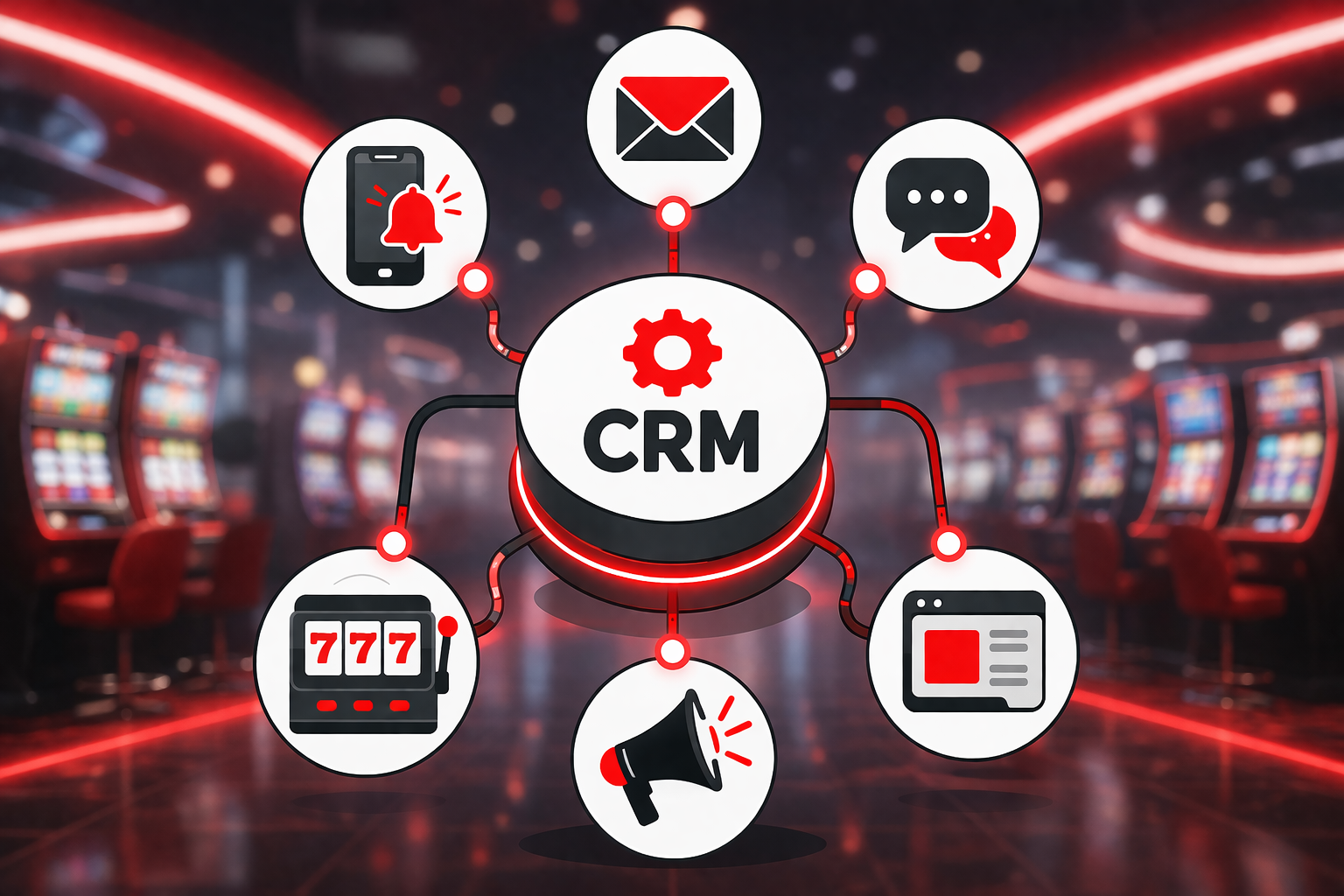
Omnichannel orchestration. Email, SMS, push notifications, in-app messages, on-site banners, WhatsApp, Telegram — all channels from one interface. According to Symplify, the best iGaming CRMs support up to 10 communication channels simultaneously.
Bonus engine. Automatic creation, assignment, and management of bonuses: welcome, reload, cashback, free spins, VIP specials. Integration with the platform’s bonus system is a mandatory requirement.
AI and predictive analytics. Churn prediction models (who will leave?), LTV forecasting (how much will they bring?), next-best-action (what to offer?). Artificial intelligence transforms CRM from a reaction system into a prediction system.
Compliance control. Automatic check before each send: is the player not self-excluded? Are limits not exceeded? Has channel consent been obtained? MGA and UKGC require an audit trail for every marketing communication. More details — in the article “Compliance in iGaming”.
Overview of CRM Platforms for iGaming in 2026
The iGaming CRM market in 2026 consists of about a dozen specialized solutions, each with its own strengths. Below is a comparison of key platforms by critical parameters.
| Platform | Focus | AI/ML | Channels | For Whom | |
|---|---|---|---|---|---|
| Optimove | Predictive analytics | Prescriptive + Generative AI | Email, SMS, push, in-app, web | Enterprise operators | |
| Fast Track | Real-time automation | Built-in ML | Email, SMS, push, in-app | Medium/large | |
| Smartico | CRM + Gamification | AI churn prevention | Email, SMS, push, in-app | All sizes | |
| Symplify | Omnichannel | AI optimization | 10 channels | Medium | |
| InTarget | Player lifecycle | Segmentation + automation | Email, SMS, push, webhook | Startups, SMB | |
| CleverTap | Mobile-first | Behavioral analytics | Push, in-app, email, SMS | Mobile operators |
Optimove — the leader for enterprise operators. Prescriptive AI determines the best action for each player, generative AI creates content, and each campaign automatically undergoes A/B testing with control groups. Recognized as a Gartner Visionary for the second year in a row.
Fast Track — a real-time engine used by more than 100 operators. Deep integration with gaming platforms allows responding to player behavior instantly, not in batch mode.
Smartico — a unique combination of CRM + gamification in one solution. Missions, tournaments, jackpots, spin-the-wheel — all integrated with CRM automation. For operators who want gamification as a retention tool.
InTarget — a solution for startups and growing operators. One person can manage the entire CRM without a technical team. Low entry threshold and transparent pricing.
The choice depends on four factors: business scale, product mix (casino / betting / hybrid), jurisdictions, and budget.
Player Lifecycle Automation: From Registration to Win-Back
The player lifecycle is not an abstraction, but a sequence of specific stages, each of which requires its own trigger, channel, and message. This is where CRM earns money.
The critical moment is the window between registration and first deposit. According to EngageLab, it is 24–72 hours. After that, the probability of conversion drops sharply. An automated series in this window looks like this: T+1 hour — in-app message with welcome bonus reminder; T+24 hours — SMS with limited offer; T+72 hours — WhatsApp message with direct deposit link.
Marketing communication automation map: what the CRM sends to the player at each stage of their lifecycle:
| Lifecycle Stage | Automation Trigger | Goal and Action |
|---|---|---|
| Registration | Signup without deposit (T+0) | Welcome series: T+1h in-app → T+24h SMS → T+72h email with limited-time bonus |
| First Deposit (FTD) | FTD completed | Activation: online casino guide + game selection by interests + match bonus |
| Activity Growth | 3+ sessions per week | Engagement: missions, tournaments, VIP level upgrade, personalized offers |
| Peak Activity | Stable deposits, high LTV | Retention: VIP manager, individual bonuses, cashback, exclusive content |
| Decline | Session frequency -50%, deposits ↓ | Churn prevention: personal bonus within 24h, manager call for VIP |
| Inactivity (14–30 days) | No bets/deposits | Reactivation: email chain → push → SMS → WhatsApp with exclusive offer |
| Churn (30+ days) | Complete inactivity | Win-back: special offer with time limit, exit survey |
Each trigger fires only if the previous condition remains true. Did the player make a deposit after the first SMS? The series stops. This is not spam — it’s contextual communication.
8 Best Practices for CRM Marketing in iGaming
Over years of working with iGaming operators, the industry has developed a set of principles that distinguish highly effective CRM teams from mediocre ones.
| Practice | What to Do and Why It Works |
|---|---|
| Unified Data Layer | Combine CRM, payment data, and gaming analytics in one place. Disparate systems = blind spots. For example, operator Funstage, by combining CRM and loyalty data on a single Xtremepush platform, increased player LTV by 199%. |
| Real-time, not batch | Rewards and triggers — during the session, not a day later. Batch processing (when the system updates data once a day, not instantly) breaks the reinforcement loop. The best operators send bonuses and notifications in real time — right when the player achieves a goal or is at risk of leaving. |
| Control groups | Every campaign is a statistical experiment. Without control groups, it’s impossible to measure the real incremental impact on NGR and LTV. |
| Omnichannel ≠ spam | Use channels as intended: email for long offers, push for urgency, SMS for reactivation, in-app for real-time rewards. Each channel has its own role. |
| AI for next-best-action | Let machine learning decide: which bonus, what size, at what moment, and through which channel to send to a specific player. Manual segmentation simply cannot do this — too many variables. |
| Compliance-first approach | Auto-check before sending: not self-excluded? Limits not exceeded? Consent obtained? One regulator fine costs more than any CRM. |
| Churn prediction < 14 days | If you react to churn after 30 days — you’re reacting to a corpse. Predictive models should trigger at the first signals: 3–7 days of declining activity. |
| Player-first, not bonus-first | Personalization is not “10% cashback for everyone.” It’s: the right game, the right moment, the right offer for a specific player. |
According to Xtremepush Gamification Benchmarks 2026, operators who combined CRM and loyalty platform on a single data layer achieve Day-30 retention of 30–40% — twice the average (15–25%).
Communication Channels: What, When, and to Whom
The channel is not a matter of preference, but a matter of matching the message type, regional infrastructure, and lifecycle stage.
Email — the main channel for long offers: welcome packages, detailed VIP program terms, monthly reports, win-back offers. Not suitable for urgency — open rates in iGaming are 15–25%.
Push notifications — ideal for real-time triggers: “Your favorite slot has been updated,” “Tournament starts in 10 minutes,” “You’ve reached a new VIP level!” Instant delivery, but requires caution — excessive frequency leads to opt-outs.
SMS — the highest open rate (90%+), but also the most expensive channel. Ideal for reactivating “dormant” players and critical time-limited offers.
In-app messages and on-site banners — communication during the session. Personal offers in the casino lobby, congratulations on achievements, reminders about incomplete missions.
WhatsApp and Telegram — fast-growing channels in Latin America, Southeast Asia, and CIS. WhatsApp for VIP communication, Telegram — for crypto audience and Generation Z. Important: gambling advertising through these channels is subject to platform policies and local legislation.
About mobile experience and the specifics of mobile-first audiences — in the article “Mobile Casino: Why Smartphones Are Replacing PCs”.
CRM and Regulatory Compliance
CRM in iGaming is not only a marketing tool but also a compliance tool. Regulators require that every communication with a player be documented, verified for compliance, and available for audit.
GDPR and data protection. Tracking cookies, email subscriptions, push consents — all require explicit consent. CRM must store consent history and allow the player to revoke it at any time. This is especially relevant for operators working in EU markets.
Responsible Gambling. CRM must automatically exclude from marketing mailings players who have set limits or undergone self-exclusion (GAMSTOP, Spelpaus). Bonus offers to players showing signs of problem behavior are a direct path to a fine. More details — “Responsible Gambling: Requirements and Best Practices”.
Audit trail. Every sent message, every trigger, every bonus accrual — must be logged with timestamp, reason for sending, and consent status. MGA conducts desktop reviews of CRM processes as part of license audits.
How to Choose a CRM: Checklist for Operators
There is no single right CRM. The choice depends on the specific situation. Here are questions to ask yourself before making a decision.
What is your product mix? Casino, betting, poker, hybrid? For sportsbook operators, real-time integration with live events is critical. For casinos — integration with the bonus engine and game providers.
In which jurisdictions do you operate? MGA, UKGC, Curaçao, Anjouan — each has its own requirements for marketing communications and data storage. CRM must support multi-jurisdictional compliance. More about licenses — “Online Casino Licensing: Jurisdiction Comparison”.
What is your team like? Enterprise platforms (Optimove, Fast Track) require data science and CRM teams. Startups will be suited by InTarget or Smartico, where one person can manage automation.
Do you need built-in gamification? If yes — Smartico. If gamification is already in the platform — a CRM with good integration is sufficient.
What is your budget? From $500/month (InTarget) to $10,000+/month (Optimove enterprise). ROI pays back the investment if CRM is properly configured — but only if.
Conclusion
CRM and marketing automation are not an “addition” to the iGaming business, but its nervous system. Without CRM, the operator doesn’t know who their players are, when they leave, and why. With the right CRM — they know, predict, and act before the player has time to close the tab.
In 2026, the best operators don’t work with data — they work with actions. The platform collects data. CRM turns it into personalized offers, timely triggers, and measurable results.
Start small: choose one task (for example, welcome series automation or churn prediction), implement, measure — and scale what works.
If you are planning to launch your own online casino with an effective CRM system and marketing automation, INNOVAVENTIS offers a ready-made solution — a platform with all the necessary tools for working with players, from acquisition to retention.