
Over the past decade, online gambling has evolved from a narrow niche into one of the fastest-growing sectors of the digital economy. Today, the industry is no longer limited to just slots or poker: it is a whole ecosystem that includes mobile platforms, live casinos, cryptocurrency solutions, analytics systems, and artificial intelligence.
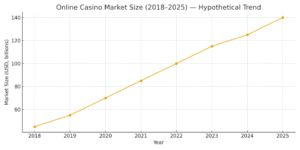
According to analysts at Statista, by 2025 the global online gambling market will exceed $130 billion, showing an average annual growth rate of 10–12%. The main drivers of this growth are digitalization, globalization, expansion of the player base, and the development of new technologies. At the same time, competition among operators is becoming increasingly fierce, while the demands from players and regulators are growing higher.
What trends will shape the industry in the coming years? Let’s take a closer look at the five key directions that are already defining online gambling in 2025.
-
Cryptocurrencies and Web3 — the New Financial Foundation of Gambling
Just a few years ago, cryptocurrency payments were seen as exotic, but today they are becoming a full-fledged industry standard. Players appreciate anonymity, transaction speed, and independence from banking restrictions. Using Bitcoin, Ethereum, or stablecoins allows operators to reach a global audience without being tied to any specific country.
The Web3 casino segment, built on blockchain technology, is developing especially fast. Here, it’s not only about the ability to deposit and withdraw in crypto, but also about the provably fair principle — when game fairness is verified through smart contracts and algorithms, open for every user to check.
For younger generations of players, this is not just about convenience but also about trust and transparency. Crypto casinos are becoming platforms where technology and gambling merge into a new business model. In 2025, such projects are no longer niche but are starting to compete with traditional platforms.
-
Artificial Intelligence and the Personalization of the Gaming Experience
Artificial Intelligence (AI) is already actively used in marketing and customer support, but in iGaming its role is becoming strategic.
The main focus is personalization. Modern algorithms analyze player behavior, preferences, betting history, and even activity time. Based on this data, the system recommends the games most likely to appeal to each user. This increases engagement, prolongs average sessions, and boosts overall platform revenue.
Another important application of AI is in responsible gambling. Systems can detect signs of potential addiction: sudden increases in deposits, frequent losses, or excessive playtime. In such cases, the platform can suggest deposit limits or a break, allowing the operator to comply with regulatory requirements and foster a responsible approach to gambling.
AI also powers next-generation chatbots. By 2025, these are not just automated responses but full-fledged virtual assistants capable of resolving issues, advising on bonus programs, and even suggesting suitable games. For operators, this means cost savings on support, while for players — a sense of care and attention.
-
Mobile and Cross-Platform Formats
Today it is hard to imagine an online casino not optimized for mobile devices. According to industry research, by 2025 over 80% of bets will be placed via smartphones. Players expect full casino functionality to be available in one click, with no delays or long loading times.
One of the key solutions here is Progressive Web Apps (PWA) — applications that combine the convenience of native apps with the flexibility of a browser. Players don’t need to download a casino from the App Store or Google Play, while the interface works as fast as a dedicated app.
Omnichannel is also essential. A modern player can start a slot game on their phone during a commute, continue on a tablet in the evening, and finish on a home computer. A smooth transition between devices is becoming a new quality standard.
Finally, simplified registration is gaining traction. One-click sign-ups via Google, Apple, or social media accounts reduce entry barriers for new users. This is especially important in a highly competitive market, where every extra minute of registration can cost the operator a potential customer.
-
Live Casinos, VR, and Immersive Experiences
Live dealer games are one of the fastest-growing segments in online gambling. Players value the atmosphere of a real casino while wanting to stay at home. In 2025, technology takes this experience to the next level.
Studios offer HD and 4K broadcasts, and the use of multiple cameras and dynamic angles creates a sense of full presence. VR and AR solutions are becoming increasingly popular, allowing players to virtually “step into” a casino hall, interact with other players, and engage with the dealer.
Gamification is another major trend. Casinos are turning into platforms where users can participate in tournaments, complete missions, earn achievements, and compete in rankings. This combination of gambling and video game elements makes the process more engaging and dynamic.
As a result, live and VR casinos are evolving from simple formats into full-fledged entertainment experiences that combine gaming, show elements, and social interaction.
-
Licensing and Regulation
The growth of the industry inevitably attracts regulator attention. If online gambling was in a “grey area” in some countries in the past, by 2025 more and more governments are implementing licensing systems.
For players, this means more transparency and security, while for operators — new rules of the game. Particularly valued are licenses from Malta, Curaçao, Anjouan, and the UK, considered signs of quality.
At the same time, requirements for AML (Anti-Money Laundering) and KYC (Know Your Customer) are tightening. Operators must carefully verify player identities, monitor the origin of funds, and report to regulators.
On the other hand, licensing opens doors to new markets. For example, Brazil and India have been actively developing legislative frameworks for online gambling in recent years. For companies, this is an opportunity to reach millions of new users eager for digital entertainment.
Thus, compliance with regulatory standards is turning into not only a legal obligation but also a strong competitive advantage.
Conclusion
The year 2025 is a time of major change in online gambling. On the one hand, players gain more convenience, innovation, and transparency. On the other, operators must invest in new technologies, adapt to stricter regulations, and fight for user attention.
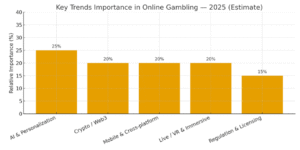
- Cryptocurrencies and Web3 give the industry new financial mechanisms.
- AI makes the gaming experience personalized and responsible.
- Mobile formats turn casinos into “always-on” services.
- Live games and VR create thrilling immersive experiences.
- Licensing builds trust and opens new markets.
The defining feature of this era is the synergy between technology and user expectations. Those operators who manage to combine innovation with player-centric care will take leading positions in the market. Online gambling is entering a new era, where success is driven by technological advancement, transparency, and a focus on the player.